

My 14 Year Old Once Called Me Transphobic. She Wasn't Wrong.
A mother-daughter argument, a lesson about desire and justice, and what the fight for trans kids reveals about us.

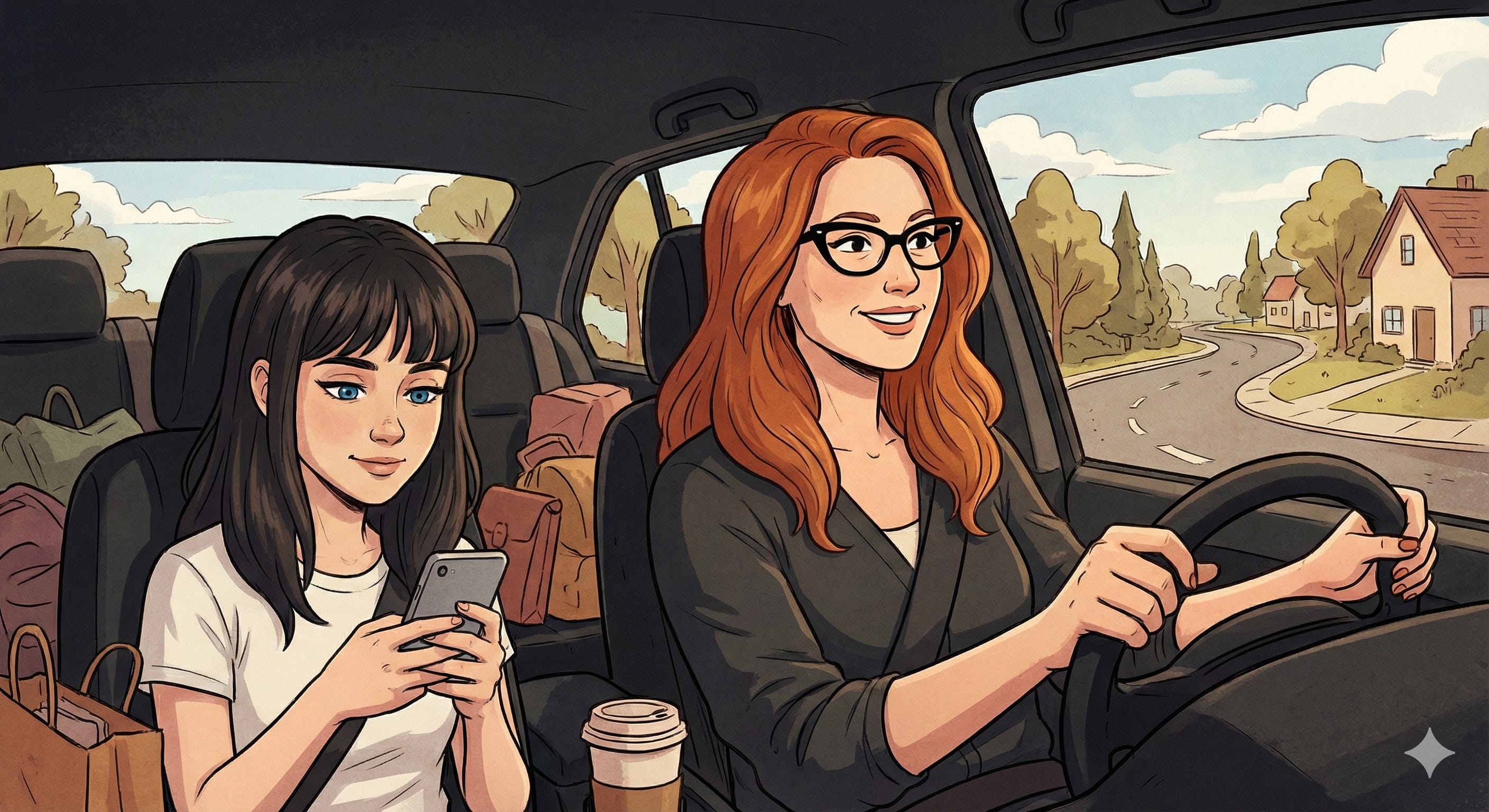
Four years ago, on a sun-blasted drive across town, my fourteen-year-old called me transphobic. I argued boundaries. She argued fairness. Back then it felt like a mother-daughter stalemate.
Now, as trans kids are targeted in public and in policy, I understand what she was really asking of me.
My favorite place to talk to my teen has always been the car.
It’s late afternoon, sunny, and I’m driving across town with my then–14-year-old daughter. She’s picking the tunes — Mitski, Taylor Swift, Phoebe Bridgers — and we’re rocking out. She loves DJing on long drives, and honestly I love it too.
Driving time is the best time to connect with my teens. We’re trapped together. They can’t retreat to their rooms, and I can’t escape into work.
Even with our bodies fixed side-by-side, moving through space at 60 mph somehow makes for easier conversations. It makes no sense and yet, it is. And she’s on the cusp of high school, where the stakes of maintaining an open line of communication get so much higher.
So I focus on the road and take advantage of how we can talk about big things without the discomfort of eye contact.
Onward we drive, chit-chatting over her playlist.
And our conversation turns to boys.
Specifically, we talk about Chris, a boy she had a crush on in elementary school who she doesn’t talk to anymore. According to her, it’s because Chris is not cool — and my cooler-than-thou child has extremely strong feelings about coolness. So I let that comment sit, in the interest of getting further scoop.
I ask, “If Chris isn’t cool, then who is?”
“Niles is cool,” she replies.
“Oh yeah? Who else?”
“Just Niles.”
Now, Niles was named Audrey when I last saw him, pre-COVID, and he was in her friend group then too. So it’s not surprising my child finds him cool. Other than the name and pronoun change, he’s still the same kid she’s always liked. But I’m curious. At her age, I certainly had a list — albeit a short one — of cool boys. Cool meaning: I wanted to date them.
So I probe. “It’s kinda strange that the only ‘cool’ boy you know is a trans boy.”
“So???!” she fires back, righteous in that way only a 14-year-old daughter talking to her mother can be. “What’s the difference?”
That’s a good question, kid.
What is the difference to her, I wonder, as she teeters on the edge of her own sexual awareness?
She’s unabashedly femme, self-assured, bold. When all her friends and her sibling changed their names and pronouns, she remained steadfast as the lone girl in the group. And she is unabashedly femme — chronically exposed midriff, a striking sense of style, someone who will almost certainly be one of the first in her cohort to make up for lost COVID time.
Knowing all this, I ask her carefully: “Is there really no difference at all to you?”
“None,” she says, instantly.
“Like… would you date a trans boy?”
Now she’s offended. “YES, MOM. Of course I would. There’s no difference!”
I barely have time to process this before she flips the questioning onto me.
“Would YOU date a trans man?”
And I answer honestly. “I don’t think so.”
She recoils, horrified. “So you just like… parts??!”
Oh, my virgin child. The audacity of you, schooling me on my own hard-won sexuality.
I take a breath. There’s no way out but through.
“You know it’s okay to have a preference for certain parts,” I say.
“Would you date a trans woman with the right parts?” she demands.
“No, I don’t think I would.”
And that’s when she goes full volume.
“SO YOU’RE TRANSPHOBIC!!!”
The conversation goes from zero to screaming-in-an-SUV in three seconds flat.
I’m not great with impromptu heated conversations. I don’t want to fight; I want to learn from her, and impart wisdom of my own. I adore her generation’s inclusivity — their sense of fairness, their refusal to put people into boxes, their moral clarity. I’ve raised my kids to use their voice, and clearly my 14-year-old is acing that part.
But here’s where I tried to make a distinction: there’s one place where you don’t have to be inclusive at all — your body.
Your boundaries are yours.
Your desire is yours.
Your consent is yours.
At the time, I framed it as empowerment: You don’t owe anyone your desire — not even in the name of allyship. You can be respectful of everyone’s bodies and identities and still only want what you want. We all deserve partners who want us for the entirety of who we are — parts and all.
She listened. Somewhat. Her shoulders lowered; the rage dissipated. I could feel her processing. She didn’t want to talk about it anymore. And then she escaped back into her Spotify queue, where emotional safety lives.
“You know I’m totally fine if you date a trans boy or girl, right?” I added. She just sighed and focused on her iPhone.
Taylor Swift went back on. Conversation over. Car karaoke resumed.
We drove and sang, side by side, as I wondered how much sunk in.
I didn’t know it then, but that argument would keep echoing.
Nearly four years have passed. She’s almost eighteen now — sharp, self-possessed, and fierce in her own sexual agency. Watching her step into adulthood feels like watching a bird test her wings in slow motion: tentative, then certain, then unstoppable. I feel ready for her to fly into this world. Almost.
And I also feel something else — something I didn’t quite understand during that drive.
My daughter wasn’t just talking about her own boundaries. She was talking about fairness. About safety. About not making trans kids prove their humanity before being considered dateable or lovable or worthy.
At the time, I thought her certainty was idealistic teenage absolutism. Now? Now I see it as moral clarity.
Because the world she was imagining — one where trans boys are just boys, where desire and identity aren’t weaponized — is not the world we live in.
I see now how naïve I was back in 2021, to believe that was the world she and her peers would inhabit. I assumed our culture, our country, couldn’t backslide. I cringe now at how wrong I was — and at how much the political landscape has darkened.
Trans kids have been turned into pawns. Across dozens of states, bills have targeted gender-affirming care, bathrooms, school sports, and even library shelves. Their autonomy — the very thing my daughter was defending in theory — is being shattered in practice. Rights I once assumed were unalienable are, in fact, alienable. Easily. Cynically. Cruelly.
And I ache for them.
I ache for the kids who don’t have homes where they can call out a parent without fear. I ache for the ones legislated into silence. I ache for the ones caught between adolescence and a country that refuses to see them.
Looking back, I think my advice made sense. And more importantly, so did my daughter’s indignation.
Both things can be true.
My boundaries were about my own body, and those still stand. But hers? Hers were about justice — a world where everyone gets to be wanted, safe, protected, free.
I’m glad she called me out. I’m glad she challenged me. I’m glad she reminded me that our kids are not only inheriting this world; they’re reshaping it.
And I hope — years from now — when she looks back on that car ride, she remembers that I listened. That I tried. That I stayed open, even when it stung.
And that we kept driving and singing, side by side, toward a world that still needs people like her — people who believe in fairness so fiercely they’ll shout “MOM, YOU’RE TRANSPHOBIC!” if they have to.
I know I’ll remember it. All too well.
Greetings!
I’m Dana DuBois, a GenX word nerd living in the Pacific Northwest with a whole lot of little words to share. I’m a founder and editor of three publications: Pink Hair & Pronouns, Three Imaginary Girls, and genXy. I write across a variety of topics but parenting, music and pop culture, relationships, and feminism are my favorites. Em-dashes, Oxford commas, and well-placed semi-colons make my heart happy.
If this story resonated with you, why not buy me a coffee?
(Make mine an iced oat milk decaf mocha, please and thank you.)
A wonderful piece. It’s interesting, as I myself often seem to embody equal parts your perspective and your daughter’s.
Still, there are often times where I fully embody your daughter’s view, while understanding your boundaries assessment and, yet, other times where it seems to flip.
The gendercentrism narrative we have been fed, I am 46, is like a scar that is always there, if we choose to notice it. However, if we choose not to, we might somehow be able to train ourselves out of our toxic upbringings and our parent’s and the peers’ naive bungling on understanding that identity is everything and that people, regardless of how they identify, deserve to be who they feel they are.
I always knew I wanted to be a transgender woman, but I grew up in the 80s/90s and the realities of that experience were much different then than they are today. I never considered it as a valid lifestyle until well into adulthood and even then, I never felt brave enough to fully embrace and commit to the identity I wanted.
Once I reached puberty I knew I was attracted to women and felt no chemistry towards masculinity. But I knew I also wasn’t even remotely interested in being a boyfriend or a husband so I never dated. Even well into my thirties there was no thought given to even considering a transgender partner. I don’t know if it was the parts I was more concerned about, or the fear over assumptions that I’d be paring with someone as messed up as me.
Now, into my mid-40s, I absolutely would date a trans woman. I’ve since had exposure to other people like me and discovered that I do feel chemistry, and that I don’t really care about parts.
So, yeah. I was a transgender person who was also transphobic… in the literal sense of the word that I feared people like me.
But you can’t really fight your chemistry. If you’ve met a bunch of transgender people but still don’t feel the spark, that’s not something you can help. I believe that true transphobia involves a choice, even if usually that choice involves avoidance and ignorance.